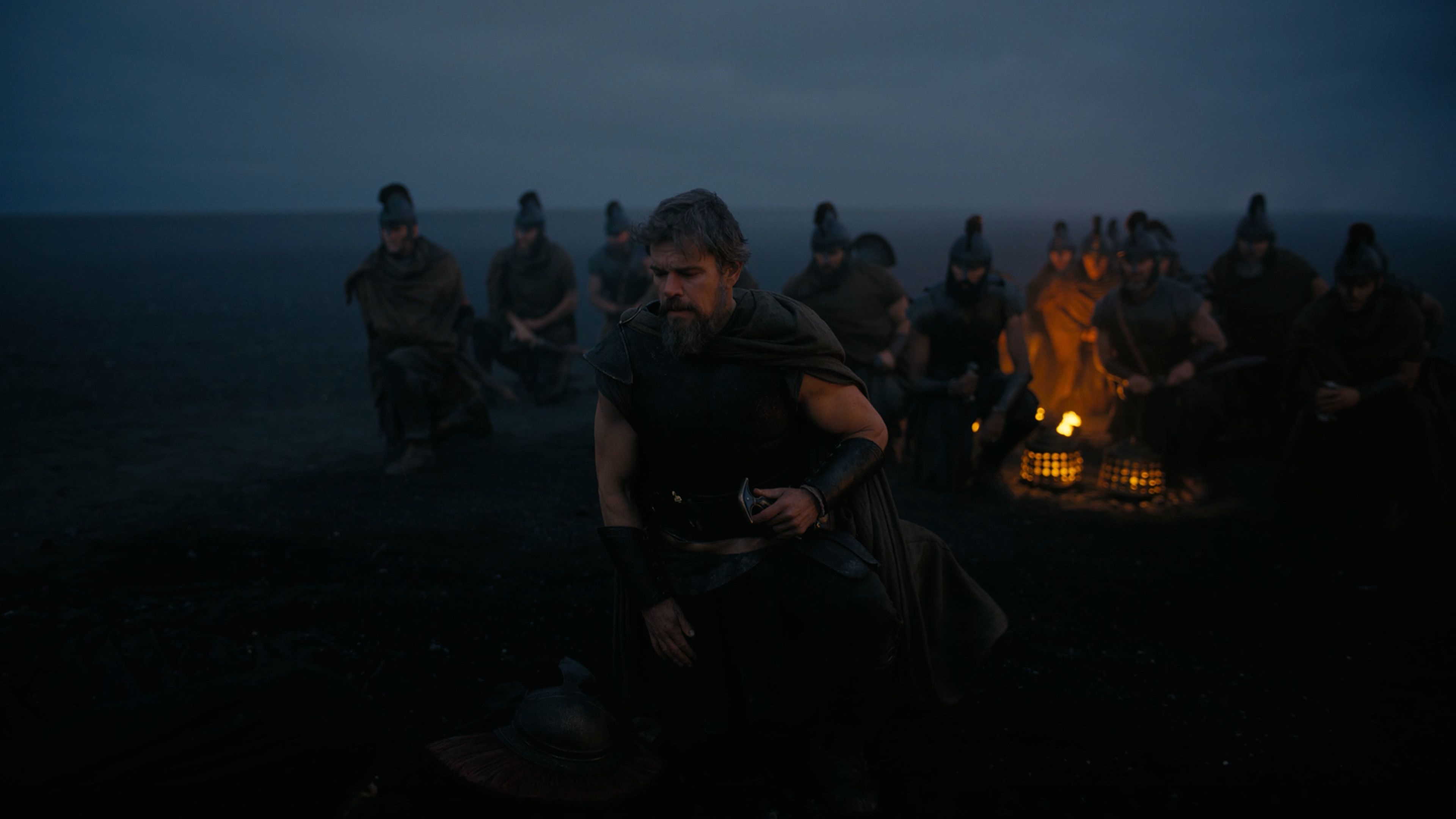
Nolan has never been a director who trusts a single timeline to carry a grief, and The Odyssey confirms that reflex with a vengeance. The film fractures the ten-year voyage into overlapping temporal strata—Odysseus's psychological unraveling bleeding into the suitors' siege of Ithaca, Athena's interventions punctuating scenes like sudden cuts in a Zimmer score that never resolves its own chord. On IMAX, the sea sequences are genuinely staggering; the Cyclops episode and the encounter with the underworld are built from practical sets and water tanks at a scale that makes the CG mythical entities feel incidental rather than central, which is exactly the right instinct for a director who learned his grammar in the trenches of Oppenheimer and Dunkirk. Matt Damon, by the fourth act, has shed the polite athleticism of The Martian and wears Odysseus like a man whose skin no longer fits him. The performance is not transcendent, but it is the most physically committed thing he's done since The Bourne years, and the film rewards that commitment with close-ups that linger just long enough to register the cost.
The structural problem, and it is a problem, is that Nolan's non-linearity here functions as a thesis rather than an experience. The timelines are told to be non-linear through intertitle cards and color-graded shifts; they are not felt as disorientation. Compare the temporal architecture of Memento or Tenet, where the viewer's confusion is the point, to The Odyssey, where the fragmentation serves to externalize guilt without ever letting us inhabit it from the inside. Damon's Odysseus is a man being described as psychologically unraveling rather than a man we watch unravel in real time. The film's greatest structural crime is that Penelope, for all of Anne Hathaway's luminous presence, is confined to a parallel timeline that the editing treats as a holding pattern—a grieving wife stitching a tapestry that the narrative promises to resolve but never quite earns on screen. Hathaway is magnificent in three or four set pieces, particularly the confrontation with Antinous, and then the film simply stops giving her room to breathe. Zendaya, conversely, gets the more interesting architectural role as Athena, appearing across every timeline as a kind of narrative operator, but the character remains a plot device dressed in bronze armor.
Robert Pattinson deserves the longest paragraph, because Antinous is the film's genuine surprise. Nolan has cast the role not as a brute but as a seducer—Pattinson's Antinous speaks softly, smiles too late, and his violence is always one beat behind his charm. In the suitors' feast scenes, which the film stages with the claustrophobic, table-to-table blocking of The Dark Knight Rises, Pattinson turns a mythological stock character into something genuinely sinister, and his chemistry with Holland as Telemachus carries the father-son tension the Odysseus storyline ultimately can't sustain. Holland, by contrast, is asked to perform a coming-of-age arc in maybe forty minutes of screen time across the fractured timeline; it's insufficient, and the film knows it, folding Telemachus into the final challenge with a briskness that feels like a plot point rather than a character.
The final challenge—the disguised return, the bow contest, the massacre of the suitors—is staged with the mechanical precision of a Nolan set piece: every camera move choreographed, every explosion timed to a Zimmer hit. It is technically flawless and emotionally muffled, a sequence that trusts spectacle to do the work that the preceding two hours failed to build. The Odyssey is a landmark of scale and ambition that nonetheless confirms Nolan's persistent inability to land in a human interior. It is the best film he's made since Inception and the most disappointing since Interstellar, and the difference between those two sentences is the entire problem with this director's relationship with grief.