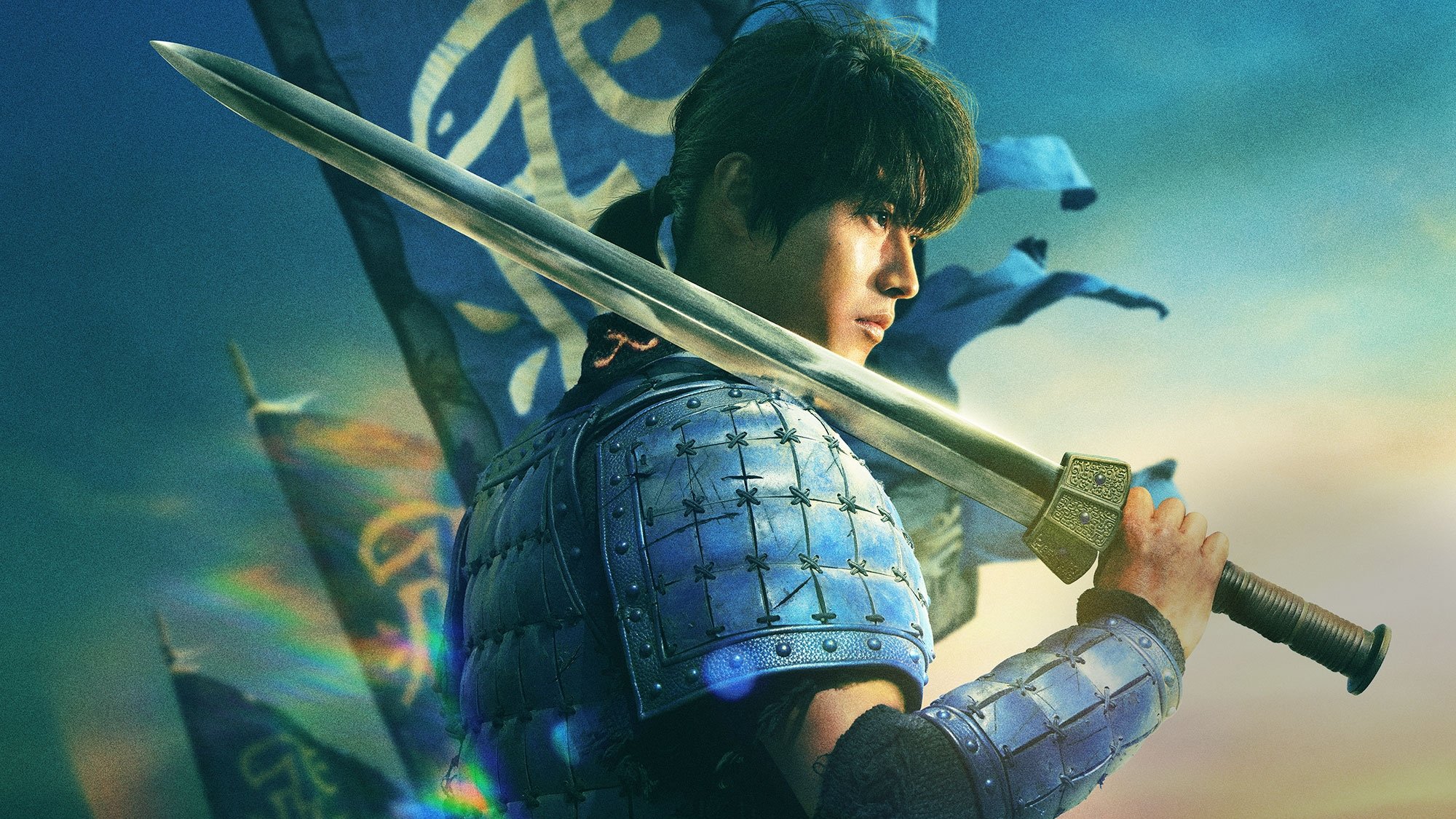
The most telling decision in Kingdom 5 is also its most dangerous: by the fifth installment, the film has no war to build toward, no political labyrinth to unravel. Li Xin's Fei Xin force is already forged; the dream of a unified China is already spoken into existence. So director Takeru Kitano—and if he is not directing, the creative apparatus he inherited—makes the radical choice to collapse the entire narrative into one campaign, one rival state, one long column of armored men grinding across open plains. It is the logical endpoint of a five-movie saga that has spent thousands of minutes earning the right to simply watch a battle happen without apology. And for the first two acts, it earns that right. The camera lingers on the geometry of formation—the way the Fei Xin line folds like a river around a ridge, the way the rival generals' cavalry is baited into a kill-zone by a feigned retreat that takes forty minutes to execute—and there is a genuine, almost architectural patience here that the earlier films, with their political subplot padding, never allowed themselves. The plains become a score, and the editing cuts not on impact but on the before of impact, the half-second of tension before ten thousand men decide together to move.
What the film cannot escape, however, is the gravitational pull of its own franchise history. Li Xin at this stage is not discovering who he is; he is performing who he is for an audience that has watched him do it in four prior films. The speeches—ambition, brotherhood, the unification dream delivered with that particular manga-born rhetoric where a man addresses the sky as though the sky owes him a response—land with the force of a man reading his own eulogy back to a crowd that has already memorized the cadence. The "high-emotion" register the synopsis promises is present, but it is the emotion of a ritual rather than a revelation. When Li Xin addresses his vanguard before the final clash, we are not learning; we are being reminded. That is not inherently fatal, but it demands a performance so textured, so willing to show the cost of repetition, that it might redeem the circularity. Takeru Kitano, to his credit, plays the scene with a stillness that suggests a man who has given the speech a hundred times in the dark before a fire, and that small interiority keeps the set piece from collapsing into pure spectacle. But it is a narrow margin.
The ten-thousand-extra battle sequences are, in the raw material sense, the most accomplished the franchise has produced. The open-plains choreography avoids the muddy, close-quarters claustrophobia of earlier installments and instead works at a scale where individual soldiers become brushstrokes and the enemy general's elite guard becomes a dark smear against sun-bleached grass. There is a shot—mid-campaign, during the rival state's counterflank—that holds for ninety seconds on a single helmeted head turning slowly to watch its own army get enveloped, and the sound design strips everything to the creak of leather and the wet thud of a boot in mud. That shot is the film at its best: a war epic remembering that war is, at the individual scale, an act of watching other people die while you are too far away to intervene. It is a small, precise, and genuinely devastating image in a two-and-a-half-hour film that is otherwise content to ask you to feel large feelings about large things.
Kingdom 5: The Clash of Souls is a film that knows exactly what it is: the capstone of a saga, the moment the machinery finally stops pretending it is building toward something and simply runs. What it lacks is a reason for us, the audience who have followed this man for five films, to feel the ground shift under the ritual. It gives us grandeur. It gives us patience. It gives us that single helmet turning in the mud. What it does not give us is the one thing a fifth film must give: the sense that the character has outgrown the myth. And so we leave the theater impressed by the architecture, moved once by a face in the dark, and then immediately back in the marketing cycle of the next installment.